
The 19th and 20th centuries saw a shift to larger scale food processing. A wide range of foodstuffs which had previously been prepared in the home, or at the very least on a small scale in local communities, became processed in substantial industrial sites serving a wide area. That being said, some food processing remained common at home into recent times. For example, jam-making and bottling of vegetables was widespread in the period before easy access to freezers. Even in the mid-20th century some families would undertake activities like making their own ham and bacon. Indeed, surveys conducted in the early 1970s found that a significant proportion of Scottish rural families were still keeping a pig for their own consumption (Fenton 2007, 288-289). We should be careful about overstating the speed or extent of mass production of foods prior to the 21st century. Further research into the ways in which different supply chains and commercial and domestic food processing interacted would be of interest.
Dairy products have long played a significant role in Scotland. However, the 19th-century saw developments in the production and processing of milk products. This was partly driven by urbanisation. The substantial market for milk, cheese, and cream in towns led to these items being brought in from the surrounding countryside, as well as supporting some urban dairies. For example, in the 1840s it was reported that many farms in the parish of Newlands churned the milk daily, and sent butter and butter-milk up to Edinburgh two or three times a week. Other farms made a mix of butter and cheese, with the butter sent weekly to Edinburgh by carrier, whilst the cheese was sold ‘at the end of the season’ (Findlater 1845, 139). These small dairies on rural farms, and the transport associated with them, arguably deserve greater research. Indeed, more could be done generally to link up the scattered evidence regarding 19th-century milk processing. For instance, fragments of ceramic dairy bowls are sometimes recovered from dwellings, and may relate to domestic processing of milk and cream (Mitchell et al 2009, 11).
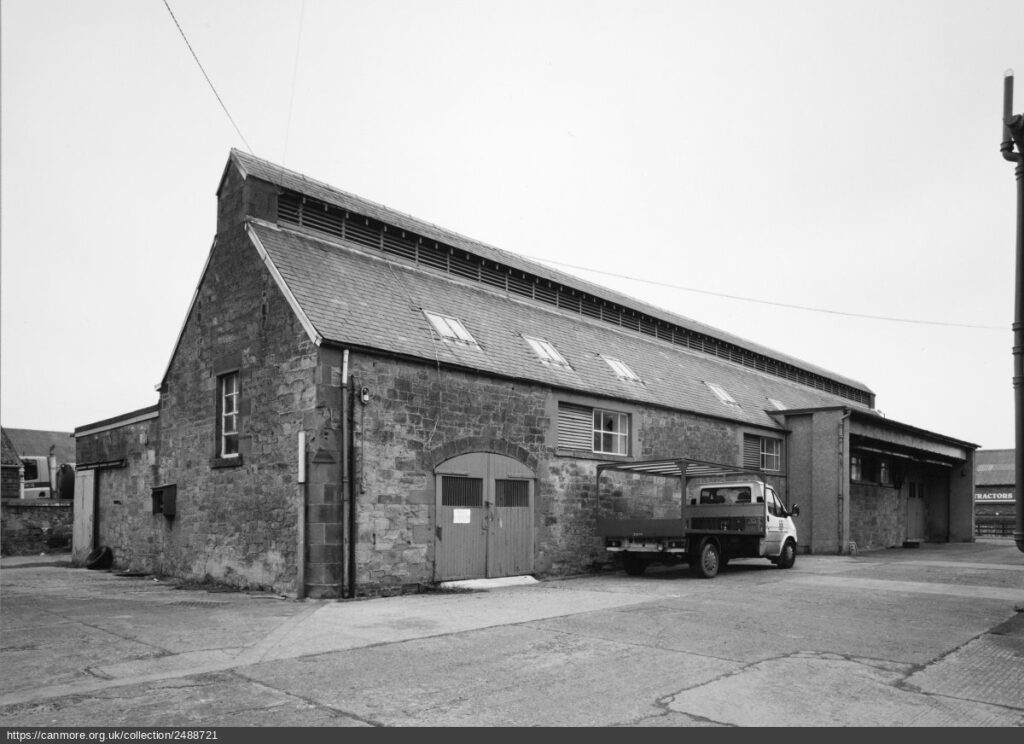
The late 19th and early 20th centuries saw the development of national dairy chains. An early example of the involvement of national chains in the region was that of the Maypole Dairy – a company which originated in the English midlands, but which by the early 1900s had a significant presence in Scotland. The Maypole Dairies often had distinctive branding, including mosaic tiles with the firm’s name on the floors – extant examples of these mosaics can be seen at former Maypole Dairy shops on the Canongate in Edinburgh and on Galashiels High Street. Some of the region’s larger commercial dairies have had a degree of study. For instance, in 1998 RCAHMS undertook a photographic survey of the former Mitchell’s Dairy site in Kelso. However, the vast majority of the region’s dairies have no systematic recording. Given the historic importance of dairying for the region, and in particular for the economy of the Borders, this is a significant gap in our understanding.

During the 19th century meat was processed both commercially and on a domestic basis. There is reason to think that in some areas the early 19th century saw an increase in families and small farms keeping pigs (Jamieson 1845, 79). In the 1840s the ministers of Haddington reported that local farm labourers routinely kept ‘a pig to consume the offal and refuse of the garden’ (Lorimer and Cook 1845, 11). Both wet and dry curing of meat, and in particular pork, appears to have been common in private households, and more research into this small-scale meat processing would be of interest.
The modern period also saw large-scale slaughtering of animals and preserving of meat – especially in urban communities. In the early 19th century much of the slaughtering in Edinburgh took place at the Nor Loch Shambles. The Nor Loch Shambles were destroyed in the 1840s to make way for Waverley Station, and for a short time afterwards the killing of animals for meat appears to have been more widely dispersed across the city (MacLachlan 2005, 64). In response, the civic authorities intervened, and in the 1850s Edinburgh established the publicly-owned Fountainbridge Slaughterhouse (MacLachlan 2005, 66). Slaughtering at other sites in the capital became outlawed. The Fountainbridge site remained the main slaughterhouse in the city until 1903, when slaughtering moved to Gorgie. Part of the Fountainbridge slaughterhouse has been excavated, as has the site of the Edinburgh Ice and Cold Storage Company which was established nearby at the end of the 19th century (Bailey 2019, 8).
The Ice and Cold Storage Company was one of a number of innovative schemes for preserving food which developed during the 19th century. Notably, the 1830s saw the foundation of John Gillon & Co. in Leith, which specialised in producing tinned meats and soups. By the 1860s John Gillon was reputedly offering 500 varieties of preserved meats, vegetables, and soups (Bremner 1868, 478). Such firms served both the local area and sent quantities of goods overseas – with Leith’s mariners providing a strong market for preserved foods. Further research into the extent to which physical evidence can be found for early tinned goods in Edinburgh and its environs could be of interest.
The South East of Scotland has a long history of fishing and fish processing. By the mid-19th century it was already common to preserve fish on ice. In 1845, the minister of Hutton in the Borders noted how salmon caught in the Tweed were sent by sea to London ‘packed in boxes with ice’ (Edgar 1845, 160). Aside from ice, a variety of traditional strategies were employed in the 19th century to preserve fish. For instance, in the 1840s Eyemouth was exporting dried, smoked, and pickled fish (Turnbull 1845, 329). The Scottish Borders have an exceptionally large number of sites identified as having played a role in the fish preserving and packing industry, most of which have had limited study. More consideration of these sites would be desirable.

Grain remained integral to the Scottish diet during the 19th and early 20th centuries. The region has a large number of granaries and grain mills. Water power remained significant in driving grain mills well into the modern period. Indeed, new watermills were still being built in the mid-19th century, often on a larger scale than in earlier periods. For example, the substantial old grain mill at Eyemouth was constructed in the 1840s and driven by water diverted from the River Eye. The National Library of Scotland has recently undertaken a mapping project of 19th-centuy watermills. However, more research into the region’s granaries and mills is needed.
The modern period saw significant changes to brewing and distilling in the region. During the 19th century beer production was concentrated in a small number of large breweries. This pattern is clearly apparent in Edinburgh. At the end of the 18th century Edinburgh and Leith had 72 breweries. However, by the end of the 19th century the capital’s beer production was dominated by the Abbey Brewery in the Canongate, which made a quarter of all the ale produced in Scotland (Dennison 2018, 200-202). The Canongate was historically a hub for brewing activity. Excavation of the Holyrood Parliament site revealed 19th and early 20th century development of the buildings and wells of the Scottish and Newcastle Breweries (Holyrood Archaeology Project Team 2010). There were also breweries and distilleries in the Tollcross area of Edinburgh, and the early 19th-century Lochrin Distillery site has been excavated (Bailey 2019). Nevertheless, more research into brewing and distilling, both in the capital and across the wider region could be undertaken.
Food Processing Research Questions
- How did the production of cheese and other dairy products in both rural and urban areas change over the modern period?
- How did butchery practices change during the modern period? What can we learn about the rise and decline of local slaughterhouses?
- How did the storage and processing of grain change during the modern period?
- To what extent were the grain mills of the 19th and early 20th centuries located on the sites of historic mills?
- How did fishing practices and the processing and transport of fish change during the modern period?
- What can we learn about the cultivation, transport, and processing of fruit and vegetables?
- What can we learn about brewing and distilling in the region during the 19th and 20th centuries?
- How industrialised was food processing prior to the late 20th century?