
The nineteenth and twentieth centuries have seen dramatic changes to places of worship in South East Scotland. The period up to 1914 saw a major increase in the number of churches in the region. This was partly driven by the rapid population growth of the nineteenth century. However, it was also attributable to the growing number of Christian denominations present in the region. The twentieth century saw continued religious diversity. Churches for various Christian denominations continued to be built, although at a slower rate than in the nineteenth century. The mid and late twentieth century also saw an increasing number of non-Christian places of worship, such as the Edinburgh Central Mosque.
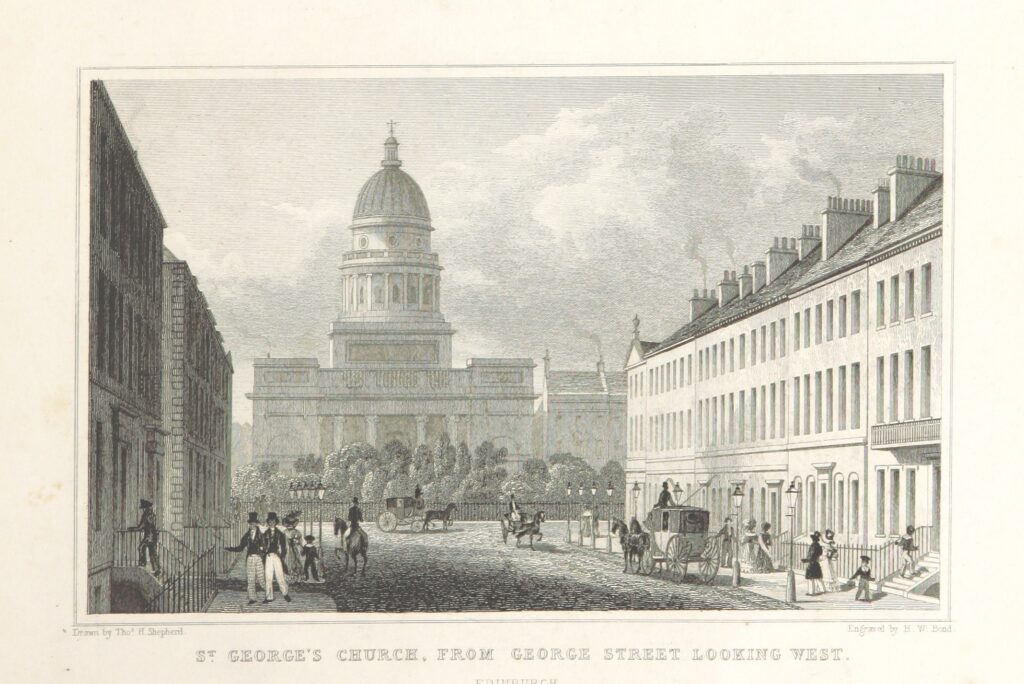
Within Christianity, the modern period has arguably been characterized by the use of a wide range of architectural styles for church buildings. At the beginning of the 1800s many of the region’s new churches were influenced by Classical architecture. A striking example of this style is the former St George’s Church in Charlotte Square in Edinburgh. This domed building with an Ionic colonnade on the street frontage was constructed by Robert Reid in the 1810s in the Roman revival style (Lindsay and Walker 1973, 31). In the 1960s St George’s was converted into an archive, and now forms the National Records of Scotland’s West Register House.
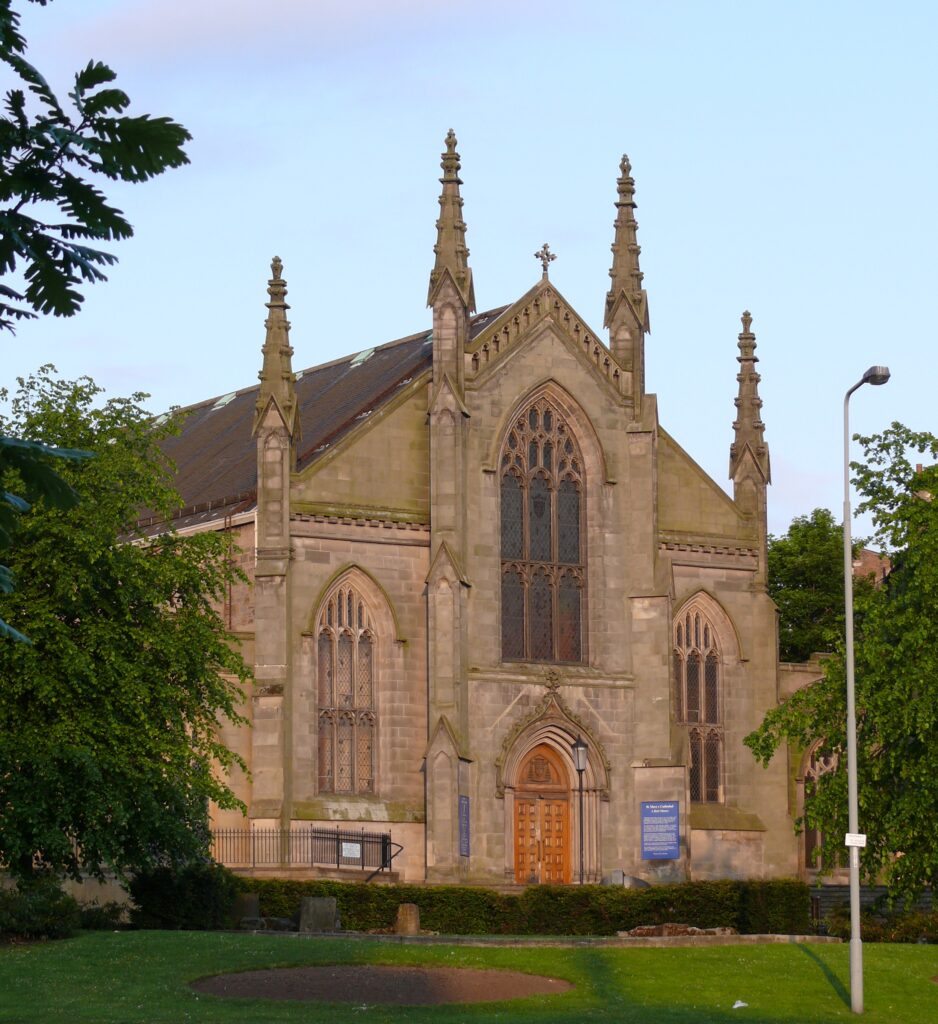
The mid nineteenth century saw increased medieval influences on church architecture in South East Scotland. One of the earliest Gothic revival churches in the region was the Roman Catholic Chapel on Broughton Street – now St Mary’s Metropolitan Cathedral. The Broughton Street Chapel was designed by James Gillespie Graham around 1813 and had echoes of English perpendicular architecture (Gifford et al 1984, 278-280). The original building has been profoundly altered, although parts of Graham’s Gothic façade survive. The choice of a Gothic style may have been chosen as a reminder of the Catholic Church’s medieval heritage. However, by the mid-nineteenth century Gothic influences were also heavily apparent in Protestant church architecture, particularly in buildings of the Scottish Episcopal Church and the Church of Scotland.
Classical and Gothic architecture co-existed in church design for much of the nineteenth century. Yet some congregations did not have the resources or inclination for grand architectural efforts and had largely practical buildings. Like many parts of Scotland, the South East had a number of corrugated iron or ‘tin’ churches. Most of these no longer exist, as tin churches were often intended as temporary structures prior to the construction of a more substantial building. For example, Queen’s Park Chapel in Dumbiedykes in Edinburgh was originally a tin church, but this was replaced in the 1880s by a stone church known as St Margaret’s – which in its turn was demolished in the 1970s (Swanson 2023). A small number of extant tin churches have been identified in the region by the Survey of Corrugated Iron Churches (Clark 2021). Notably, there survives: the building which is now Yetholm Heritage Centre in the Borders, the former Merchiston UPC in Edinburgh, which is now part of a scrapyard, and the Royal Edinburgh Hospital Church, now the Hive Activity Centre.
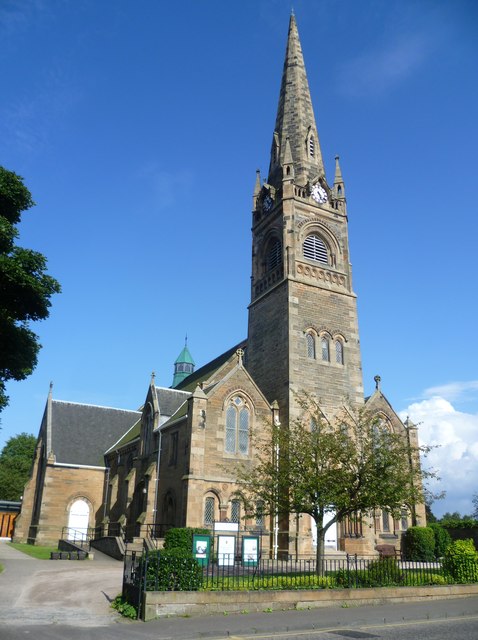
The twentieth century saw some churches built in a traditional style. However, this century also saw the introduction of modernism to ecclesiastical architecture. A notable example is St John’s Church at Langlee in the Borders. St John’s was constructed in the 1970s to a design by Anthony Wheeler (Strang 1994, 203). As is the case with a number of modernist churches in Scotland, St John’s was built as part of a new social housing development. In general, though, the number of modernist churches constructed was limited, in part because the mid and late twentieth centuries saw fewer churches built than in the period before the First World War.
Declining church attendance and changing trends in places of worship has meant that the modern period has been characterized by the demolition of large numbers of churches. In the nineteenth century churches were typically demolished because the congregation a new and often larger building. In contrast, in the twentieth century demolition was often triggered by a congregation closing or moving to a smaller place of worship. For example, West St Giles Parish Church in Marchmont in Edinburgh, closed after the congregation joined with another parish. West St Giles was then demolished in 1974 (Swanson 2023). In many cases demolition followed a failed conversion to other uses. This was the case for the Barony and St James Church on Albany Street in Edinburgh, which was for a time a theatrical costume store after ceasing to function as a church, before eventually being demolished in the 1980s.
A significant proportion of closed churches in South East Scotland have been converted to other uses – with varying degrees of success. In the light of the pressures on many Christian congregations and the Church of Scotland’s plans to reduce its ownership of churches, it is likely that the next decade will see a large number of church buildings being adapted to alternative uses. In the past this has often led to ecclesiastical interiors being stripped out during the process of conversion. For example, when St George’s became West Register House most of its interior furnishings and decoration were removed. Arguably, interiors are one of the most vulnerable aspects of church buildings. Conversions of churches to other uses and changing fashions in worship, for example, a preference for moveable chairs rather than fixed pews, are driving major changes to historic ecclesiastical interiors. Yet these interior features are often of significance. Structures such as pulpits, pews, stained glass, and memorials provide important information about the evolution of worship in the region. They also give information about Scottish craftsmanship and communal identities. Even heating systems and older lighting arrangements can give insights into how the lives of the residents of South East Scotland changed over the modern period. In response to the Church of Scotland’s large scale closure of churches, projects to record these buildings have been established by Historic Environment Scotland and by the Society of Antiquaries of Scotland, working in collaboration with Scotland’s Churches Trust. However, the scale of recording required means that it is likely that many churches will not receive the level of detailed study which would be desirable.
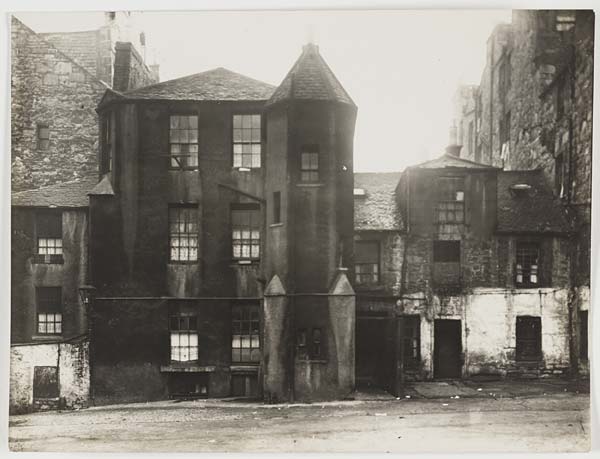
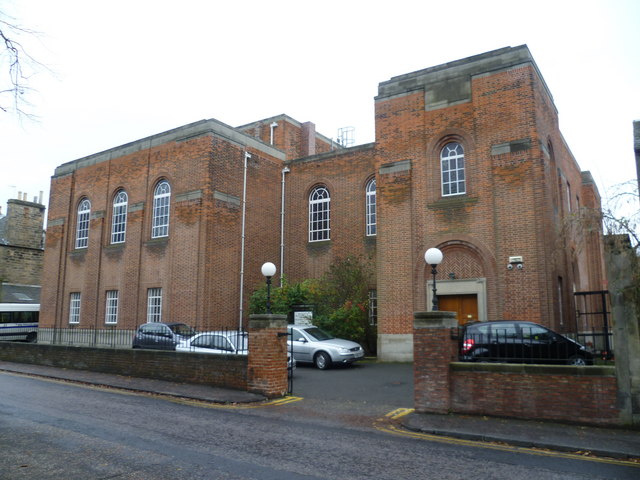
The modern period has seen a significant rise in non-Christian places of worship in South East Scotland. Edinburgh has had a Jewish community since at least the seventeenth century. In the 1820s, Jewish families in Edinburgh established their own synagogue in a former tenement in Richmond Court in Newington. This was replaced in the 1860s by a synagogue at Ross House in Park Place. Several further synagogues opened in Edinburgh during the late nineteenth century, all in buildings converted from other uses. The first purpose built synagogue in the region was constructed in the 1930s on Salisbury Road in Edinburgh. The nineteenth and twentieth centuries also saw the arrival of Muslims in Scotland – with one of the first named Muslims in the country being an Indian student named Wazir Beg who is believed to have studied at Edinburgh University (https://blog.historicenvironment.scot/2019/06/celebrating-ramadan-scotland/). At the end of the 1990s the purpose-built Edinburgh Central Mosque opened. The design of the mosque combines traditional Islamic architecture and elements of the Scottish baronial style. Further research into the range of sites used by Jews, Muslims, and other minority faith groups in the region during the nineteenth and twentieth centuries would be desirable.
Religious Buildings Research Questions
- To what extent did the design of places of worship in South East Scotland follow wider national and international trends?
- How significant was denominational identity in shaping the layout and appearance of church buildings?
- How were older church buildings adapted to serve the needs of modern congregations?
- In what ways did church interiors change during the modern period? How did the design of pulpits, communion tables, seating arrangements, and memorials evolve over time?
- To what extent was there a shift away from plans which prioritised preaching?
- In what ways did the design of urban and rural churches differ?
- How much difference was there in the appearance and layout of churches in rich and poor areas?
- How did the surroundings of churches change during the modern period?
- What can we find out about private chapels?
- What can we learn about prefabricated religious buildings (e.g. tin churches)?
- What can we discover about the closure, conversion, and abandonment of churches during the nineteenth and twentieth centuries?
- What can we learn about the development and design of non-Christian places of worship?